
Why Trade Wars Between Countries Affect Your Online Shopping
You sit on your couch, open your favorite shopping app, and start adding things to your cart. Phone case. Sneakers. Kitchen gadget. None of it feels “political.”
Yet the price you see, the shipping time, even whether that item is available or not can all be shaped by trade wars between countries.
Let’s break down why trade wars between countries affect your online shopping in simple, everyday terms.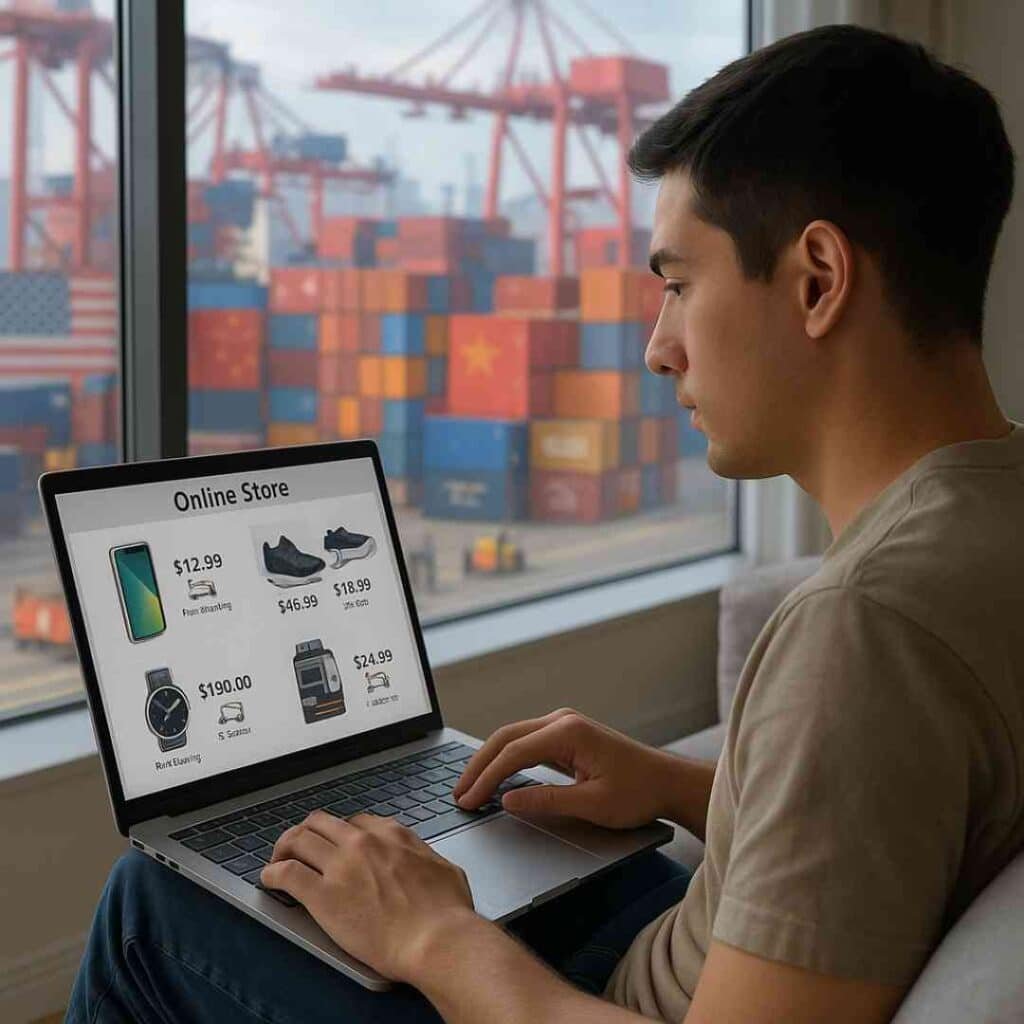
What is a trade war, really?
A trade war is what happens when countries start fighting each other using tariffs and other trade barriers instead of weapons.
A tariff is a tax on imported goods. When one country slaps tariffs on products from another country, that country usually reacts with its own tariffs. Back and forth. That back-and-forth is the trade war.
If you want a simple textbook-style definition, you can check this clear explanation of trade wars from Britannica.
It sounds distant, but that fight over taxes at ports around the world quietly reaches your shopping cart.
How a tariff turns into a higher price in your cart
When a government adds a tariff, the tax is paid by the importer in that country—the business bringing the goods in, not the foreign seller. That importer doesn’t want to lose money, so the cost usually gets passed along the chain.
The chain often looks like this:
Government adds tariff to certain products (for example, electronics from a specific country).
Importer pays the extra tax when goods enter the country.
Wholesalers and retailers raise prices to protect their profit margins.
You see a higher price on the product page when you shop online.
Research on recent trade wars shows that in many cases, the tariffs were passed through almost completely to consumers in the form of higher prices.
So when you wonder why that gadget you bought last year is suddenly much more expensive this year, a trade fight in another part of the world might be part of the answer.
Why your favorite online deals start to disappear
Trade wars don’t just raise prices. They can also change what even shows up when you search.
When tariffs hit certain products or countries, some importers simply stop bringing those items in because it is no longer profitable. That means less variety for you.
You may notice things like:
The color or size you want is always “out of stock.”
A brand you liked quietly disappears from your usual marketplace.
The replacement options look more generic or no-name.
Studies of the U.S.–China trade war found that tariffs not only cut imports from targeted countries; they also pushed importers to switch to other suppliers, often in different countries.
So the cute mug that used to come from a small factory in one country might now come from a different country, with different quality, different design, and a different price.
Trade wars and your shipping time
You’ve probably had this happen:
The item is cheap. The reviews are good. But the delivery window suddenly stretches from “3–5 days” to “2–4 weeks.”
Trade wars can be one of the hidden reasons:
Tariffs push sellers to reroute goods through other countries.
Some products get inspected more often at customs, which slows things down.
Sellers switch to cheaper shipping methods to offset higher import costs.
All of this adds friction to the supply chain. When governments raise barriers, goods take more detours before reaching you. That delay shows up as a delivery estimate that makes you think twice before ordering.
Why some online stores raise prices… and others don’t (at first)
Not every website reacts to tariffs the same way.
Some big platforms can absorb part of the cost for a while because they want to keep you hooked with low prices. Others quietly raise prices on certain categories, or add “handling fees” at checkout.
You might see:
A sudden “service fee” added near the end of checkout.
Higher free-shipping thresholds (“Free shipping over $75” becomes “Free shipping over $99”).
Bundles and “value packs” replacing single-item purchases.
Behind the scenes, they are trying to manage higher import costs without losing customers. But long term, broad tariffs almost always push prices up somewhere—on the product, the shipping, or both.
Small online sellers get squeezed the hardest
If you buy from independent sellers on marketplaces or small Shopify stores, trade wars can hit them even harder.
A small seller doesn’t have the same negotiation power or financial cushion as a big brand. When tariffs rise:
Their cost per unit jumps.
Their profit margin shrinks fast.
They may have to raise prices or stop selling certain imported items altogether.
Some respond by switching to local suppliers, which can be good for domestic businesses but may mean higher prices or simpler designs. Others shut down certain product lines that no longer make sense.
For you as a shopper, this looks like fewer unique finds and more of the same mass-produced items.
Digital life still depends on physical trade
You might think, “I mostly pay for digital stuff—streaming, apps, subscriptions. Trade wars won’t touch that.”
But even digital life sits on physical hardware:
Phones, tablets, and laptops.
Routers and modems.
Game consoles and accessories.
When tariffs hit electronics or components, device prices can climb, and upgrade cycles get slower. That affects how often you replace your phone or buy a new laptop for school or work.
So even if your main “shopping” is inside apps and games, trade wars can still change the cost of staying connected in the first place.
What you can do as an online shopper
You can’t stop a trade war by yourself, but you can adapt.
Here are practical things that help:
Compare local vs imported
Sometimes a locally made product is only slightly more expensive but avoids the wild price swings caused by tariffs.Watch for hidden fees at checkout
Keep an eye on “import fees,” “handling,” or “service” lines when you check out, especially on cross-border orders.Check alternative sellers and markets
If your usual marketplace shows big price jumps, try other reputable platforms or direct brand stores. Some will have better supply routes or stock.Buy a little earlier
For seasonal items or gifts, ordering ahead gives you room to deal with slower shipping.Invest in quality, not just the lowest price
Replacing cheap items more often can end up costing more than buying one slightly pricier but durable product.
And if you like following how headlines turn into real-world changes in your cart, you can test yourself with this interactive news quiz on global trade and the economy. Keeping up with the news makes the price changes you see a lot less confusing.
Why trade wars will keep touching your cart
Trade fights between countries are not going away. Governments use tariffs as tools for many reasons: protecting local jobs, pressuring other countries, or responding to security concerns.
Every time that happens at scale, it pushes on:
What gets imported
How much it costs
How fast it moves
All three show up directly in your online shopping experience: prices, availability, and delivery times.
So the next time you see a sudden jump in the cost of something simple—sneakers, headphones, a frying pan—it might not be just “inflation” or “greedy sellers.” It might be a trade war playing out far from your home, but very close to your cart.